Showing posts with label Software Architecture. Show all posts

Tuesday, June 7, 2022

Key encryption key to work with key rotation policies

Enterprise requires security at every level. The data at transit as well as at rest needs to be encrypted. This got more important when enterprises started hosting in cloud providers. Simple encryption using a key is fine, but there are scenarios where the key needs to be changed. In the cryptography world, it is called Key rotation¹. 
When we rotate keys, there are many questions such as should we keep the old keys to decrypt stored data? if so how long and how many old keys do we need to keep?

Background

The basics such as what is the encryption key? What is symmetric and asymmetric encryption² are skipped here. Directly going to the enterprise practices.
  • Encrypt the data at rest³
  • The encryption key should be rotated in a fixed interval.
  • The key management should be in the hands of the enterprise even in the cloud. No cloud-provided managed keys.
Why we are rotating the keys is to secure data even if the key is leaked and the attacker didn't try to decrypt within the rotation interval.

Problem

If we simply use one key and change it, we cannot decrypt the old data unless we keep all old keys associated with the data. If the frequency of key rotation is a month or year, it's fine we can keep the keys. But if the key needs to be rotated every day or 12 hours, it would be difficult.

In case the key is leaked, the person obtaining the key can decrypt the old data. 

Why can't we re-encrypt?

We can think of why can't we decrypt the data with the existing key and encrypt it again with the new key? Technically it is possible but it's an intensive computer process that requires a lot of resources. Depending upon the amount of data, compute resource availability, and the key rotation interval it may not be practical at all. 

By the time we decrypt and encrypt, it would be time to rotate the key again. 

Solution

There is a simple solution to it to satisfy the enterprise's needs.

Encrypt always with the same key, encrypt that key with another key and rotate the key-encryption key.
  • The first key that encrypts input data is called the data encryption key. This is often randomly generated. 
  • The key that is encrypting the data encryption key is called the key-encryption key. This is sometimes referred to as the master key⁴.
  • Keep the master key unencrypted
  • Rotate the master key in the defined intervals.
Photo credits.

If we follow this practice, we can satisfy the demand of key rotation but with fewer resources. We always use the same key to encrypt the data and then keep that key in an encrypted fashion.

Is this full proof?

When it comes to computer security it is not will it is when. Below are a few cons
  • In this key-encryption key mechanism, there is a problem if the data encryption key is leaked.
  • This involves double encryption. In order to get data, the data encryption key needs to be obtained by decrypting using a key-encryption key and then decrypting the original data.

References

Tuesday, May 3, 2022

Pipelines ➤ Platforms ➤ Protocols - Developer version

This is my interpretation of the below article from the medium.

https://medium.com/bosonprotocol/pipelines-to-platforms-to-protocols-reconfiguring-value-and-redesigning-markets-548b1fffc84

Why my own interpretation?

The mentioned article is discussing how industrialization started, and how it disrupted the market leading to the creation of value as pipelines. Then how it's disrupted by the platforms and finally how the protocols are becoming the future disruption.

Not sure how many of my readers understood the above statement. I faced the same problem. But I somehow got a feeling that there is value in the article. I read it, again and again, to understand what is it? Finally, when I felt I understood something, I thought of writing my own interpretation for the fellow readers like me who can't understand that in the first place. Especially software engineers.

Its the readers choice to read my article first then the original or viceversa

First, we need to be familiar with the 3 terms mentioned in the title.

Pipelines

What
  • One producer to many consumers.
  • Manufacturers set up assembly lines of production and a global supply chain to deliver goods.
  • It is mostly linear from souring raw material, running a production factory, transporting to the consumer market, advertising, selling, and after-sale support.
  • The producer is mainly responsible for finding and reaching out to the customers.
  • If malpractice or hacking succeeds, only the producer and its consumers will be affected.
Examples
  • Car manufacturing, Textile, Electronics, and consumer goods where producers reach out to consumers.

Platforms

What
  • Many producers and many consumers interact within a centralized platform that verifies the transactions.
  • Distributed production than centralized production in pipelines.
  • The platform basically provides market infrastructure and matches supply and demand. Uses personal matching preferences too.
  • Platform charges fees or makes use of producer and consumer data to make money.
  • Less privacy as the platforms need personal information.
  • A producer can become a consumer and vice versa quickly. eg: Yesterday I stayed on Airbnb, tomorrow I am listing my basement. I read and write posts on social media like Facebook, Twitter
  • Platform decides the rules for producers and consumers and standardizes interaction.
  • Internet is essential to sustain platforms though there were old platform models such as farmer's markets, and shopping malls that connect producers and consumers.
  • Malpractice or successful hacking into the platform affects relatively a large population that is on the platform.
Examples
  • eCommerce - Amazon, eBay, etc.
  • Apple app store, Play store, etc...
  • Social media & news - Twitter, Facebook
  • Publishing - Blogger, WordPress, YouTube, etc...
  • Transportation - UBER, Lyft
  • Hospitality - Airbnb

Protocols

What
  • Decentralized blockchain and smart contracts govern the transactions.
  • Transactions verification and enforcement of smart contracts can be done by producers and consumers or third-party miners.
  • The contract code is auditable by the market players than a document given by the platform owner.
  • The protocol doesn't provide market infrastructure. Instead, it encourages players to set up by giving protocol tokens. Token value is directly proportional to the usage of the protocol.
  • NFT (Non-Fungible Tokens) helps producers establish and transfer property rights. Consumers get verifiable asset ownership.
  • Identity protection.
  • Governments have less control except to identify a bad actor and request everyone else not to work with the bad actor.
Examples
  • Metaverse. (Infrastructure will be provided by metaverse developers and device manufacturers where the value is stored and transferred using underlying blockchain and smart contracts)
  • Financial protocols such as AAVE
  • The NFT market such as OpenSea

What is the takeaway?

Now we understood some terminologies. Let us see what the article says.

During the pre-industrialization era, production was decentralized into small units without leveraging technology. Then the pipeline model came with the help of the steam engine followed by electricity. It revolutionized production. Then platforms came and won the market with the advanced technology of the internet. Often we can see when the company that follows the pipeline model competes with a company following the platforms model in the same business domain platform model is winning.

The future is of protocols. Protocols are expected to win when competing with the platform business models. 

Should all businesses move to protocols?

I am not sure at this point. If there is a monopoly, you may continue your pipeline business model. Indian railway is the biggest monopoly I have ever seen. But they are also trying the platform model by inviting private train operators. That will help them compete better with the other means of transportation.
The same applies to the stock exchange which provides a platform for buyers and sellers. I am not aware of any protocol where I can buy actual Apple (AAPL) stocks in whole or as fractions without paying the brokers. Oh maybe having a look at Terra Luna Mirror protocol, may change our perspective. But still, traditional exchanges have a monopoly.

What does it mean to developers?

We are in the early days of platforms to protocol transition. Kind of how people were wondering what to do with the internet in the 90s. Below is my advice to fellow developers. This is applicable if you are not afraid of change, to be in the market to build great products and make more money.
  • Learn how the protocols world works. Think about how it can be used in the real world. Get hands dirty with protocol code ie write smart contracts.
  • If your company is still following the pipeline business model and platform competitors are coming to the domain
    • Try to convince the company to transform into a protocol model skipping the platform model.
    • Or at least to platform
    • Move to a platform company, in case change is considered an enemy in your company.
  • If your company is in a successful platform business
    • Try transforming to a protocol model.
    • Move to protocol business company, if the change is not welcomed.

Tuesday, July 27, 2021

Zero Trust security model

This post is about a design approach for loosely disconnected components of a system or a group of networked devices. Those components are normally different processes serving WebAPI, Database, or consuming applications. Or if wet think from networking aspect those are different devices inside a network. Mainly those are inside a perimeter network of an enterprise. 

More than programming, this is about enterprise architecture and no code snippets. Please continue if interested. 

What's before Zero Trust Security Model

Before Zero security model, there were models where only the external endpoints are protected. Whatever happens inside a trusted network area is considered secure. Some examples below

  • An AD server simply responds to the requests that come from a web server inside the trusted network.
  • If the webserver only exposing 443 for external traffic and uses 80 for internal services, it simply responds to requests in 80 without authenticating. This is on the assumption that the request can only originate from within that server.
This is applicable when the network is fully managed and has a clearly defined boundary

Zero Trust model

When systems became more cloud-friendly or hybrid, they started spanning across multiple networks. For example, it is not feasible to store big data within the enterprise network. Often they are offloaded to cloud services. That is the place where that data can be analyzed using modern big data tools such as Spark. 
Sometimes due to regulatory requirements data needs to be stored on-premise but compute can be in the cloud. They may need to run big Spark clusters on the cloud but needs to access the data from on-premise storage.

Often those networks are not controlled by the enterprise. The concept of inherent trust is no more applicable in this new world.

This is the reason for the Zero Trust model to get importance. This term is coined by John Kindervag in the year 2010 but there seem traces of this term from 1994 according to the internet. From my perspective more than who invented it, I focus on what is it.

The main pillars of the Zero Trust model are the centralized identity of users, devices, and applications, verification of those identities before serving, authorization based on lease privileged access, assume there can be a breach but make sure the firewalls, API gateways, and monitoring are in place, a segmented network so that the surface area is very less.

The Zero Trust model implementation guidelines are available for the major clouds such as Azure, AWS, and GCP. Also available for the Kubernetes clusters where people host microservices.

References

Case studies

This is a buzzword like what Microservice, Serverless was one time. Knowingly or unknowingly we will reach this model as the cloud is inevitable for enterprises. Please note this was there in Thoughtworks technology radar in 2020 but later removed.

Tuesday, July 20, 2021

Azure @ Enterprise - Why I recommend Kubernetes as app hosting platform?

I started writing this post 2-3 years back. Mainly when Apache Spark 2.3 started supporting Kubernetes (K8s) in 2018. It was obvious that Kubernetes is taking over app hosting space the same way virtual machines took over physical machines. All are expected to understand where the industry is moving and adopt. Hence I paused this post as there is nothing I need to endorse. But it's time to resume this post and publish it.

If you are already using container and K8s orchestration, feel free to skip this post and save time.

Basics

Containers

Please refer to my 2015 post about Software Containerization via Docker - First look and some thoughts for very low-level basics. The container can be understood as a micro virtual machine with the application(s) and runtime isolated from each other. It has a file system inside it, it can expose ports for networking. Mount external storage.

This mainly co-evolved with the microservice architecture where the huge systems are separately developed and deployed as small services that own their own data and release cadence.

Kubernetes

Officially 
"Kubernetes is a portable, extensible, open-source platform for managing containerized workloads and services, that facilitates both declarative configuration and automation." - Kubernets.io

In short, it is the container orchestration engine.

What is and why do we need container orchestration?

 In my own words, orchestration is  
  • Where to run
    • Horizontal scaling - Mechanism to use multiple nodes(VMs are called nodes) to run containers of the same system. Nodes are expected to fail at any time.
    • Deciding where to run the container - The mechanism to specify what node executes what container. Eg: a particular container in the solution may need to run on the Linux node another may need a Windows node. Some containers may need GPU to be present on the node
    • Can also include virtual nodes that even can use Azure Container Instances.
  • Deployment and rollback
    • Ability to rollback easily in case something goes wrong in deployment
    • It is expected to have failures in deployments but the orchestration system should be able to roll back easily to the previous known state.
  • Networking
    • Determine how the containers are allowed to communicate with each other and what ports are exposed to outside.
    • Also has load balancing capability
    • Also has routing capability.
  • Service discovery
    • The services/components in the system should be able to discover the endpoints to other services as the services may be deployed to multiple nodes.
  • Resource allocation
    • Determines how much system resources need to be given to each container.
  • Storage mounting
    • Ability to mount external storage
  • Scaling
    • The mechanism to specify how many container instances are to be running at a time. Eg: Based on Azure queue messages it has to scale out / horizontal scale.
  • Secret and configuration management
    • Secrets can even be stored in Azure KeyVault and places like that. But that may not work on-prem. An orchestration engine needs to have secret management.
    • Configuration management is another aspect of any software system. The containers need to be initialized with proper configuration wherever it runs.
  • CRON
    • Capability to execute a container based on CRON expression.
  • Health monitoring & self-healing
    • Monitor the state of the containers and make sure the state is true to the definition of the system. Eg: If a container crashes, the orchestrator makes sure it's started again.
Hope the above explains what and why orchestration?

Links

There are people out there who can explain orchestration better than me.

Why Kubernetes?

It is the currently available best container orchestration engine. It supports most of the capabilities mentioned in the above list of what and why orchestration. For further reading refer to K8s documentation.

What Kubernetes is not?

It is equally important to understand what Kubernetes is not for. They
  • Don’t have native CI/CD concepts.
  • Don't have a data storage engine. RDBMS Rollbacks are not supported out of the box. Better be backward compatible. 
  • Don’t have a built-in blue-green deployment strategy
  • Don’t have a built-in serverless function or event-driven execution
  • Don’t have a built-in message broker, service bus, etc… we have to use external or run a container for message broker.
More in their documentation.

How and where to host

K8s can be run on top of virtual or physical machines or in the cloud.

On-premise

It can be installed on-premise on top of virtual machines or physical machines. The machines are called nodes as well. Control nodes need to be Linux, worker nodes can be either Windows or Linux. If your organization is a hard-core windows shop, no luck here.

Cloud

Major cloud providers provide an easier way to host K8s applications.

Why Kubernetes is good for enterprises?

  • Vendor-neutral and portable
    • If cloud providers increase fees, easy to switch from one vendor to other
    • Worst case start and maintain on-prem K8s cluster
    • Never do own cluster if you are a start-up and hosting a single application.
  • No vendor lock-in due to native PaaS model
  • Environment parity
    • Less 'it works in my machine' comments from developers
  • High density
    • Can pack more things in resources. Less wastage.
  • Multi-tenancy
    • Multiple apps of the enterprise can share a single cluster via namespaces-based isolation.
  • Fewer operations cost
    • Due to high density and multi-tenant nature less operation cost to make the cluster up and running.
  • A clear view of architecture
    • Just reviewing the YAML files will give a clear idea of how the system is designed. No more surprises because the settings and configurations are spread across many places.
  • Repeatability
    • Since the container is immutable, it can be used years later if we want to see how the app did run earlier.
  • No need for private cloud software
    • An on-premise cloud can be created on the K8s cluster without any private cloud software such as OpenStack. The K8s cluster is the cloud where applications are separated by namespaces. Oh yes, the storage needs to be managed.

Learning curve

It will not be an easy journey to the Kubernetes. Engineering teams (Dev and DevOps if you have separate teams) need to be upskilled as there are a lot of new concepts in K8s. Some below
  • Namespaces
  • Nodes - Control and worker nodes
  • Controllers - ReplicaController, NodeController
  • Deployment
  • ReplicaSet
  • Pod
  • StatefulSet
  • DaemonSet
  • Service
  • Job, CronJob
  • Volume, Persistent Volume, etc...
  • ConfigMaps
  • Secrets
  • Policies, Resource Quota
  • Selectors
  • YAML (Not that specific to K8s)
  • Kubectl
I didn't get a comprehensive mind-map showing all so planning to prepare one. It is advisable to upskill the team by hiring external people who already have experience with K8s. Converting an existing team that doesn't know K8s to experts is tough unless you are ok to accept failures.

Tuesday, December 15, 2020

Azure @ Enterprise - Serverless scale problem - Functions in App Service Environment connecting to Azure SQL

This post is about working with Azure Functions in App Service Environment hereafter ASE. Not sure it is qualified to call a classic problem but we all get into trouble when we use the serverless scale model. That is mainly due to the inability to scale by the dependencies of the Serverless compute tier.
To be more clear the Azure Functions will scale out but underlying dependencies such as Azure SQL will not scale with Functions and eventually lead to system failure.

Problem

Let us take a scenario. There is Azure Function that is invoked by the Azure storage queue. There will be one instance of Function running all the time. When the queue has more than 100 messages in the queued state, the Function will scale out to 4 instances to complete processing. Then scale down to 1. 

Each Azure Function instance can dequeue the maximum of 32 messages in a batch.32 is a hard limit.

When the scale-out happens the Azure SQL fails as it cannot accept more connections.

Observations

The SQL server sp_who2 command shows there are a lot of connections in the sleeping state from the Function instances.
The Azure SQL is in General Purpose Gen 5, 4 vCores tier. It can accept only 400 connections.

Root cause

.Net has a default connection pool size of 100. There are other applications also connecting to the same database apart from the Function. 4 Function instances wanted to establish 4x100=400 connections which are not possible with the Azure SQL tier as the other applications also making a similar number of connections. Hence it says cannot accept more connections.

Solution(s)

There can be multiple solutions
  • Scale up the Azure SQL tier to General Purpose Gen 5, 8 vCores that can accept 800 concurrent connections.
  • Throttle the .Net connection pool to 32 or 64. This number is based on the maximum number of messages dequeued by one Function instance. So max connections from all 4 pools will be maxed 128 or 256. There are some left for the other applications as well.
  • The Serverless Azure SQL tier is an option. But please understand that the Serverless compute has a warmup delay after idle usage periods hence best suited for intermittent and unpredictable workloads that can afford this delay.

Happy Serverless

Tuesday, July 23, 2019

Setting up PlantUML for coding C4 architecture diagrams - Video Tutorial

At last I published a video tutorial. As always its very difficult to get the first job done, if its a different type of job.

The tutorial is about setting Visual Studio Code with PlantUML to code C4 architecture diagrams  as explained in one of my previous post.

Since I don't have the right recording equipment and not a native English speaker, I used a text to speech service. It is AWS->Polly service. I didn't feel somehow the voices in Azure are good. The voice is US English Male voice named Matthew.

You tube link is given below and also embedded.
https://www.youtube.com/watch?v=Zt3Bj1HMJ8g

Tuesday, June 18, 2019

PlantUML - Code, Generate and Publish Mind-maps from GitPages

Introduction

This post mainly aims to provide an idea how we can use PlantUML to create mind maps and host them from GitPages without spending anything. It obviously need a computing device with browser and internet connection.

PlantUML

No need to have introduction again, as there were posts written earlier on the same. Just to summarize
  • It is a textual representation of diagrams.
  • Helps to version and compare changes applied.
  • Can render in different visual formats from the same textual definitions.

Mind maps

It is diagramming model where information about one concept is represented in relation with other related topics. More on Wiki.

Coding Mind maps

The setup explained in previous post is enough for coding mind maps. PlantUML supports mind maps out of the box in latest versions as beta.

Rendering diagram

Though the ideal way to publish into web is HTML, there seems some issues in generating HTML files out of the box. So better get it into image formats and embed into HTML using <img> tag. 

If we are using our machines during development, it is easy to have control over the environment and install GraphViz and Java runtime needed for PlantUML. Now a days everybody uses continuous integration and delivery method. The CI/CD environments with full control mostly require fees and here we are trying to achieve without any cost. Let is see how to get the diagrams published in free?

One way is to use containers where entire ecosystem would be present and use it in CI/CD environment. Another way which we are going to see is via proxy service of PlantUML

Using the proxy service is very simple. The official www.plantuml.com site has a service hosted in below url

http://www.plantuml.com/plantuml/proxy?src=<accessible URL to the plantuml file>

This src query string pair accepts a source url where the PlantUML code file is present and returns converted image representation.

eg:The below URL gives the png file corresponds to the PlantUML file located at the path mentioned in src query string parameter
http://www.plantuml.com/plantuml/proxy?src=https://raw.githubusercontent.com/mind-maps/software/master/debugging/before-debugging-others-problem.puml

More details on controlling the behavior can be found in this post.

The moment we got the png back via an URL, we can easily publish using html files. No need to have CI/CD systems and dealing with containers or build environments.

Publishing

GitPages provides free sub domain based web site hosting free and we can host mind maps directly from the GitHub repository. Using the markdown, we can easily convert the above mentioned url into an link <a> or <img> tag.

eg:A link in markdown file (.md) can be denoted as below

[Debugging](http://www.plantuml.com/plantuml/proxy?cache=no&src=https://raw.githubusercontent.com/mind-maps/software/master/debugging/before-debugging-others-problem.puml)

Sample repo

Source repo which hosts the puml files & hosting .md files - https://github.com/mind-maps/software
Sub domain & URL based web site which GitPages gives for repo- https://mind-maps.github.io/software/

The .md files gets automatically converted into HTML and served. If there is index.md it would be taken as default when we didn't mention anything in the url. GitPages internally uses Jekyll and customization can be done. One such customization in the above repo is in below URL. Since Jekyll and customization is not in the scope of this post, please google for more details.

Below are not essential but just to give complete picture
Sub domain based organization URL - https://mind-maps.github.io/
Repo of organization web site - https://github.com/mind-maps/mind-maps.github.io

Enjoy documenting...

Tuesday, May 7, 2019

Node-PlantUML package to automate generation of mind map diagrams

Recently I was doing some experiments with PlantUML. PlantUML is awesome. Write code and get diagrams. It is especially great tool for engineers like me who are not that good at art. One of the main trend now a days is to automate anything and obviously we can automate diagram generation from puml file. The technology to do is obviously NodeJS.

Package to generate images from .puml files

As normal in Node world, NodeJS has a package to convert puml files into images and much more. Below is the link to the NPN package.
https://www.npmjs.com/package/node-plantuml

From here, this post assumes the reader has knowledge about NodeJS and its NPM package ecosystem.

A simple problem

If there is no problem this post is not needed. The node-plantuml package generated the diagrams for most for the puml files. But not for the mind map pumls. ie which are starting with @startmindmap.

@startmindmap
* root
** 1
**_ 3
@endmindmap

Root cause

The node-plantuml uses plantuml.jar file to bundle with it is not the latest. That jar file don't have the capability to understand @startmindmap. So it fails.

Solution

node-platuml package to include the latest plantuml.jar file. As a responsible developer, who make use of other's open source work, I should give them a PR which I will be doing soon.

Workarounds

Set the path of plantuml.jar

As any other developer, the developers of this package also left option for configuring the path to jar file. They selected the environment variable mechanism to set the path. The name of environment variable is PLANTUML_HOME. If the environment variable is not there, it will take jar file from vendor folder. Below line is from the node-plant package source code.

The code to set the environment variable to a different .jar file is as follows. If we obtain the latest plantuml.jar file, we can place it somewhere and point to the same.

process.env.PLANTUML_HOME = "node_modules/node-plantuml/vendor/plantuml_new.jar";

If there are any troubles setting the path, try the below approach.

Replace old file with new

Get the latest plantuml.jar file from VS code extension called PlantUML. The location of the platuml.jar file is below.

%userprofile%\.vscode\extensions\jebbs.plantuml-2.10.9

Put the file into the node-plantuml modules folder. Location below.

..\node_modules\node-plantuml\vendor

Tuesday, April 30, 2019

Architecture of www.JoymonOnline.in via PlantUML

The previous post was about setting up the environment for coded C4 architecture diagram using PlantUML. This post is about how the same can be leveraged for the architecture of www.JoymonOnline.in web site.

It is just a simple personal portfolio site whose architecture has already done in C4 model. The conversion is simple and its available along with the source itself in GitHub.

Below is a screenshot how it render in VS Code.

Its difficult to unless opened in a different window.

Happy diagramming...

Tuesday, April 23, 2019

Setting up PlantUML for coding C4 architecture diagrams

Background

Earlier there was a post in this blog related to documenting architecture using C4 Architecture model. The architecture of www.joymononline.in is documented in the C4 way. At least, the context diagram. The problem what was tried to solve in that post was how to make code inline with architecture.

It is easy to document architecture for a static portfolio site or a simple CRUD operations site with a login feature. But difficult in Enterprise systems especially, if the rate of change is so rapidly. Nowadays the software is changing its happening at high speed with the advent of DevOps culture and practices such as continuous integration, delivery, monitoring, etc...

Problem

When we follow any documentation model as a technical person, we may face below problems
  • Versioning with application code.
    • What if a feature branch changes the architecture or component interaction or alters dependencies
    • Comparing what changed from the last version?
  • The time-taken to beautify the diagrams. Skills depend on person to person and difficult to get it uniform when the organization grows.

Potential solution

One way we could apply is coding the architecture. Meaning, store the architecture diagrams in textual representation and store along with code. Generate diagrams out of it. It is a simple idea similar to using markdown for documents. It's human and machine-readable.

Let's see one way to document the C4 architecture model using textual language. First introducing of some terms and later see how they are smartly glued to get coded C4 architecture diagrams.

PlantUML

This is a text-based UML modeling. This has specs and free to use. It has also Java-based rendering mechanism which uses another free software called GraphViz to visualize the diagrams.

GraphViz

This is a visualization tool for creating diagrams. Its open-source. This is needed by PlantUML to render charts.

VS Code & PlantUML extension

This is the developer's favorite editor. As usual, there is an extension to easily write and preview the diagrams. The name of the extension is 'plantuml'. We can either install via extension editor or by command. Thanks to the author Jebbs for the extension and making open source.

How to setup VS Code for PlantUML is already mentioned in the below link. Since we are living in the 21st century, the Japanese language in the post can be converted automatically by the browser to English:)

C4-PlantUML GitHub repo

The magic is here. Below repo has the C4 customization files for PlantUML to understand the C4 language.

Big thanks to Ricardo for his work and especially for open-sourcing the same. The repo has enough details about the capabilities and sample to get started.

Another interesting thing he did is the availability of Azure customization. These files help us to create diagrams using Azure symbols than boring boxes.

Troubleshooting

Though some of us get the environment working in the first attempt itself, I am trying to do a video (my first tech video) on how to set up the environment for doing C4 architecture of www.joymononline.in via PlantUML notations and the tools mentioned above

If we go step by step there will not be any issues. Below are the steps
  1. First, install Java. That will make sure the PATH variable is set properly.
  2. Then install GraphViz. Even there is no issue installing in a different order as those are not dependent. 
  3. Now install the VSCode and 'plantuml' plugin. the plugin contains the plantuml.jar file. 
  4. Finally, download the customization from C4-PlantUML repo and open in VS Code. 
  5. Check the preview by Alt+D shortcut.

Once we have the environment setup its easy as typing the diagram and previewing it in the same window. Commit the file once ready. Better integrate with the build pipeline.

Conclusion

The mix of specs & tools is little complex but easy to set up and use. Though there is no support for the tools we as developers can fix the issues and add features in those tools and give back to the community

Tuesday, November 6, 2018

PowerShell to find the listening port and its process - eg SQL Server Analysis Service

Problem

Enterprise environment always enforce security in different levels. One such level is network ports. There will be less questions when we want to open port 443 for http(s) communication. Also it is fine if the ports are familiar such as 1433 for SQL Server. But when it comes to some unfamiliar ports its difficult. Also they wants to open very minimal ports. So finding and documenting exactly what ports are required is a considerable job for an Architect. This is obviously not applicable to Architects who are there when solutions or define the solution themselves. But its trouble for Architects who reverse engineer what is in the development / testing / staging environment and prepare document which is essential to move the application to the higher environment.

One such thing is SQL Server Analysis Service. For SQL Server OLTP engine its easy to find out. But for analysis service, its difficult if the installation is done using custom port.

What Google says

This is not the first time people encounter the problem and there are lot of solutions to it. Some from google are below.

To find ports and processes in general

http://blogs.microsoft.co.il/scriptfanatic/2011/02/10/how-to-find-running-processes-and-their-port-number/
https://stackoverflow.com/questions/42857466/find-process-that-is-blocking-a-port-on-windows

https://superuser.com/questions/1215093/powershell-one-liner-to-show-process-on-same-line-as-port-using-netstat-issue

Find SSAS Ports

https://support.microsoft.com/en-us/help/2466860/how-to-determine-and-change-the-port-of-an-ssas-instance
https://www.cisco.com/c/en/us/support/docs/conferencing/telepresence-management-suite-analytics-extension/112506-pqa-112506-00.html#q1

The general scripts are either based on long custom PS command or text analytics based. The SSAS port findings required 2 steps to figure port out.

Easy solution using PowerShell

Below is another one which does the things in singe PS command. Yes obviously there is piping and we can argue whether its multi-line script or not.

Finding ports and processes


Get-NetTCPConnection | `
where {$_.State -eq 'Listen'} | `
select -Property LocalAddress, `
                        @{name="Process";Expression={$psid = $_.OwningProcess; (Get-Process | where {$_.Id -eq $psid }).Name + ', ' + $_.OwningProcess}}, `
                        LocalPort ` |
sort -property Process

Pretty much straight forward. It relies on the Get-NetTCPConnection commandlet. Then does some filtering and selection to get the list back.

Finding port of SSAS Service

We can apply the above technique easily to filter the SSAS process

get-nettcpconnection | `
where {$_.State -eq 'Listen'} | `
where {$_.OwningProcess -in (Get-Process | Where {$_.Name -eq 'msmdsrv'}).Id} | `
Select-Object -Property LocalAddress, `
                        @{name="Process";Expression={$psid = $_.OwningProcess; (Get-Process | where {$_.Id -eq $psid }).Name + ', ' + $_.OwningProcess}}, `
                        LocalPort `


It takes a big assumption that the process name of SSAS is 'msmdsrv'. In future Microsoft change the name the script will not work.

References

Tuesday, October 2, 2018

Online diagramming tools

We are living in the age of easy software development and business friendly environment. Lot of things are free if we want to develop software or start a company than 10 years back. Diagramming was difficult earlier but now there are lot of tools to create good stunning diagrams. Below is a list of online browser based diagramming tools for software developers and architects. All are either free, or has freemium pricing model.

General

Below has general diagramming support as well as software engineering diagrams.

www.draw.io
https://www.lucidchart.com
https://cacoo.com

https://cloudcraft.co - AWS specific, 3D diagrams

Architecture as Code

https://structurizr.com/ - Used to draw C4 arch diagrams using code!


This list demands periodic update as new tools will appear and some fade away or move to paid model. Hopefully updates can be done at least once an year.

Tuesday, September 18, 2018

Architecture Decision Record (ADR)

Basics

Software Engineering is a relatively new field of engineering. There are still debates whether it is engineering or art. Regardless it needs an Architecture similar to other engineering disciplines. Unlike the other fields, the main challenge software architects faces is to make sure the delivered code is inline with the Architecture. With the advent of Agile which is very difficult to practice in other field, finalizing Architecture in software is really challenging. If we religiously finish architecture before coding, some other competition might have taken the market over.

But still we need to document the architecture even it is after the release. Don't laugh. It is needed to refer in future at least. Software unlike the other fields, is change friendly. It evolves really fast. There are different ways to document architecture. We can use UML diagrams, new trend of C4 architecture model etc...Even if we create beautiful architecture diagrams of delivered software, the problem is that it is very difficult to document why we took the decision. If we get a software in Silverlight, we should understand in the first place why  that technology is selected? Why there are WCF web service calls instead of ReST services? etc... Nothing happens without a reason in software development. So it is good if that reason can be recorded for future developers.


We can sit and write a beautiful document around diagrams and add the decisions. But its really boring and it becomes obsolete immediately as the software evolves. So what another approach.

ADR ie Architecture Decision Records in its simple form can be interpreted as the adoption of agile into documentation. Below is one good article about that practice.

Recently ThoughtWorks brought it to main attention. They call it as Light weight ADR. Yes in teh world of agile everything has to be light weight or at least in the name. As per the past history they promote after they had tried it in the field. There are more references about ADR which are included in the References section of this post.

Contents of ADR

When we adopt the ADR into project, the first thing to decide is what contents needed in ADR. The main problem is to make it light weight. If we add all the diagrams, meeting minutes etc... it will be another documentation nightmare. So we have to choose what fields to be included. Below link summarize many formats.

https://github.com/joelparkerhenderson/architecture_decision_record

Format of ADR

Now a days developers even write official letters in markdown. It got that much attention due to its support in opensource communities such as GitHub. So without any confusion the ADR can use markdown.

Where to keep the ADR

Another question is where to keep the ADR. Since it is small textual representation, it can be inside a shared folder, SharePoint or in email. If we keep the ADR in a place other than source code, it may not help us in future. If the ADR is with source, where ever the source goes the ADR too goes. Today it can be TFS tomorrow it can be in Git. Sometimes companies opensource via GitHub.

Since ADR don't have any relevance without source code, the better places is with code.

Open source

Now a days GitHub is the synonym of open source. They support markdown in wiki as well as in source. Lets see the differences in keeping ADR in wiki v/s source

ADR in wiki

Wiki is independent of code. The main problem is that when we branch to develop a new feature we cannot have ADRs inside branch which are needed for that feature development. We can workaround this by many means but still little difficult. The advantage is easy editing. No need to check out, commit and push to get some changes done.
Below is one example for keeping ADR in wiki.

ADR in Source

The opposite way helps us to keep the ADR with source. When we branch the ADR comes with us. If we are doing any overriding of Architecture, we can document there. The pull request can include the same which gives reviewer that there is something fundamentally happened due to this feature.

Naming

The main purpose of naming is to distinguish the ADRs. When we keep the ADR record files, either we can keep then inside a folder called ADR or prefix the files. Similarly we can sequentially number them and keep that number in the file name or inside the contents. Right now there doesn't seems to be a standard. Hopefully something will evolve soon similar to Swagger for APIs.

Some real world usage

Below is one real world usage. The ADRs are kept in below location.

Rendered as below in the documentation.

How I implemented

My open source projects started adopting the ADR. Below is one example ADR
https://github.com/KarelRobot/karel-web/blob/master/docs/adr/

Rendered as
https://karelrobot.github.io/karel-web/adr/0001-use-webpack

There are only 6 fields used to make it or call it lightweight.

References

https://adr.github.io/

Tuesday, March 20, 2018

Circular relationship diagram for Microservices and Serverless architectures

Microservices is the trend for splitting large systems to individual self contained subsystems. With the advancement of Serverless offerings more and more systems are created or moving towards Microservice approach.

Is Microservice same as Serverless?

Before we go further let us clarify the difference between Microservice and Serverless. There could be some readers who thinks both are same and Serverless is more advanced. To be frank, there are fundamental differences between these two.

Microservice - It is about splitting the systems into small sub systems which are deliverable by them selves. Microservices can be hosted either in Cloud or in onpremise data centers. Microservice has to manage its own data and that data should never be touched by other systems directly.
If the system consists of couple of services and both are maintained by same team, those services doesn't necessarily be separate.

Serverless - It is about freeing the developers from worrying about underlying infrastructure. They just have to write the code and give to the hosting environment. The environment takes care from there about scaling, fault tolerance, patching etc... to maintain a promised parameters such as  predictable throughput, OS level security etc...

Problem

The problem with Microservice is the integration of Microservices. If it is single big monolith system the integration is handled by the class relationship. When we move to Microservice the complexity is moved to the service integration level from the class level. The overall complexity of the system is not changing. It would be easy when we start Microservice based system from scratch or convert existing. But it gets difficult when the count of Microservices goes beyond 50 or 100. Especially to understand their relation to each other. Who calls who and what protocol ie ie dependency. 
The technical solution for this problem is to implement Service mesh or service discovery mechanism so that we have the connection details at central place.

But how do we create a diagram to represent those relationships. If we use traditional blocks and arrows model, it will take more time to understand than the time for coding the same. So lets take another approach.

Circular Relationship Diagram

It doesn't seems that there is a standard name for a diagram which puts the entities in the edge of a circle and shows connections by drawing lines between those through the circle. As programmers lets try to generate one by code than buying a software.

D3.JS for Circular Relationship Diagram

Most of us would be familiar with the D3.JS library for charting in the browser. That library have the support for creating circular relationship diagram. Below goes one link.

http://mbostock.github.io/d3/talk/20111116/bundle.html

The above is not intended for plotting the relationship between the Microservices. But as programmers we can easily change its data to provide our Microservice relationship. The above link doesn't need any server side coding. All it needs is web server to serve HTML pages. It can be IIS, Apache or anything.

Thanks to the D3 library and author of the sample.

Other references

https://github.com/nicgirault/circosJS
https://modeling-languages.com/javascript-drawing-libraries-diagrams/

Tuesday, January 2, 2018

ReST based Web Sites & ReSTful Navigation

Introduction

ReST is highly considered as architectural pattern for integrating systems. It mainly uses APIs
point to resource and do operation on those. The URL often follows a cleaner hierarchical path pattern without much key value pairs than conventional key value pair based URL schemes. People often follow the ReST based URL format for APIs but not widely accepted for web sites.

This post aims to investigate on bringing this ReST based URL schemes to web sites similar to APIs.

Why should I do create web sites as ReSTful URLs

The same benefit of ReST based API URLs applies here as well. The URL will be easy to remember. It is easy to have separation of concerns. New features can be totally implemented separately. using their own area / virtual directories. No need to mix with existing screens even it they are related. Simple and short URLs than lengthy story telling URLs.

eg: www.mycompany.com/employeelist.aspx?empId=1 can be easily represented via
www.mycompany.com/employees/1

Why there are not much web sites following ReSTful pattern

One reason could be the difficulty to follow the pattern. If it is product company the development team will get more freedom to select URLs. Again if the product owners don't know what is ReST and the advantages they may influence the URL pattern. In the other side the consulting industry is heavily driven by client demands. Though regular clients may not ask for particular URLs, semi technical clients may ask.

Some tips for ReSTful web site URLS

Below are some tips to design web site URLs in resource oriented way

No operation oriented screens

The screens should be pointing to resources to display those. For example the below URL displays the employee resource.

www.mycompany.com/employees/1

Lists and details screens

If the URLs display the resource how to edit them? Which screen to edit those resources? The better way is to use lists and details mechanism.

If we display the resources in a list those can be edited in the same list itself and save using a button. Here the single page application (SPA) concept helps us than navigating to an edit page.

Circular navigation

If the resources have circular relation the navigation may also becomes circular.
For example, the employee page may show the department where he belongs to as hyper link. Clicing that will navigate to dept page where it lists the employees in that dept including the manager. Going to the manager page may display employees under him and clicking on the same employee's link there will end up in same employees page where we started.

Multiple navigation paths

Similarly there would be multiple navigation paths to reach one resource. For example the home page of company may show the departments and various project it is doing currently. Navigating to department as well as project may end up in same employee page.

A powerful search experience to navigate

If a resource is buried under the hierarchy, it would be difficult to find it without multiple clicks. So better to have a search mechanism where the resource can be searched and navigated on clicking the associated URLs.

http://mikeschinkel.com/blog/welldesignedurlsarebeautiful/

Tuesday, November 21, 2017

Azure @ Enterprise - Architecture to secure PaaS

When enterprise wants to use somebody else's computer, yes cloud/Azure is essentially just somebody else's computer, they want to make sure it is secure same to their on-premise environment. At least enterprise wants to delay the attack. Never think any security solution is final. Security measures are just about 'when' the attack will happen.

Multi-tenancy and Enterprise

Cloud is all about multi-tenancy. We have to share with others and enterprise always have doubt on it. When we share, will the other guy stole our assets or attack me? Whatever the cloud vendors assure that the cloud is secure and nothing gets leaked between the tenants, enterprise don't want to be just another tenant. They want their own space.

One way is to setup private cloud infrastructure inside enterprise. But it has upfront investment and lose the glory of auto scaling. So that is not the best options unless the security is the first concern.

Enter virtual networks

In order to give own space to enterprise or anybody who don't want to be another tenant, cloud providers started giving virtual networks. It ensures that our cloud resources are accessible only within the boundary of vNet and to have external communication separate gateways/tunnels are needed. They also support seamless connection to the enterprise's on premise network via VPN. That way enterprise can just lift and shift their classic virtual machine based solutions to Cloud and slowly adopt the cloud native features

In Amazon, it is called as VPC (Virtual Private Cloud) and in Azure it is simply virtual network or vNet for short.

vNet limits in Azure

Though there is vNet in Azure not all platform services are vNet ready. For example, we can put a virtual machine easily into vNet but Storage Account cannot. (Feature to limit Storage Account access to vNet is beta at the time of writing). Platform service such as AppService can be hosted inside vNet using a costly feature called AppServiceEnvironment.

Authenticating to platform services

Enterprise normally don't want to keep any secrets in application configuration. eg: Password to database connection should never be kept in web.config in case of an ASP.Net web application. Instead the app has to run under a specific IIS application pool and app pool user will be added to the database server hence app can use windows authentication. Or the authenticated user can be delegated to database directly. Again depends on the nature of application. We can ask then, what is the login password of app pool user? Is one or persons knowing it not a problem in enterprise?

In enterprise people changes often. If the identity is with people, it is easier to manage than keeping password in config. There are chances that someone in support may send the config file in mail or keep in \\shared drive etc... If it is app pool user and the password is with single team who installs the application, it is relatively safe. At least that is what enterprise believe.

Coming back to Azure. Not all Azure resources/platform services(PaaS) support windows/active directory based authentication. The application must preset password when it authenticate against the PaaS. So it demands apps to keep secrets such as passwords and connection strings with password in it. 

Enter KeyVault

Microsoft suggests to use a PaaS called KeyVault to keep secrets. It has HSM (Hardware Security Modules) and much more features. Then the question from enterprise turns out to be "Does KeyVault support vNet?" Answer is No. 
Should we keep the KeyVault's connection string with password in application's config? Then what is the difference between keeping database's connection string with password v/s KeyVault connction string with password in application's config?

So how do we protect KeyVault. If enterprise needs to be just another tenant in KeyVault, how to ensure the security? This post is about one way how can we protect connection to KeyVault which will protect other resources.

Architecture

The key message is simple here. 
In order to connect to KeyVault use certificate instead of password in application's config. 
Rest is circus we do to get all working together. We can use Azure Function to talk to KeyVault and vNet to protect that function so that nobody from outside can access that Function. Only that Function needs to know the certificate and registered as Azure AD App etc...

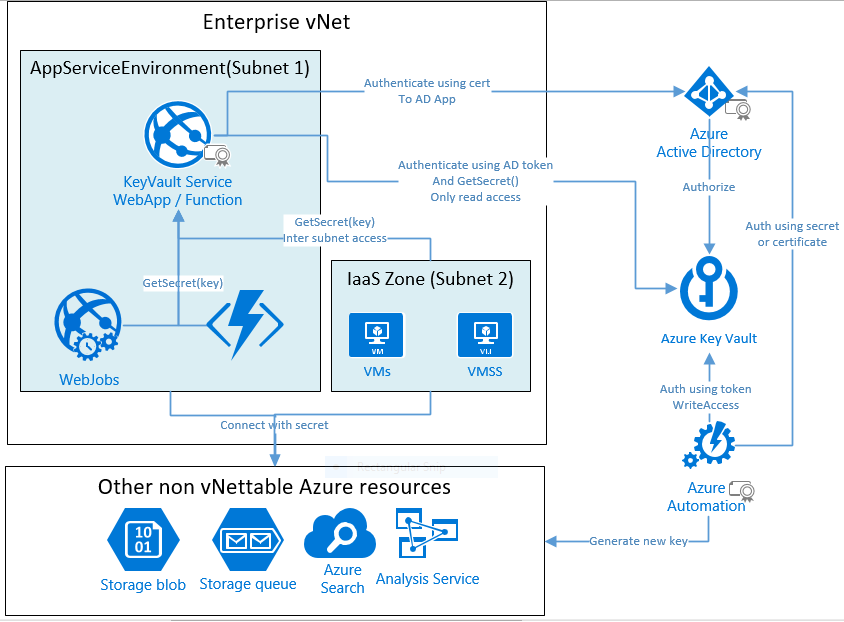
Diagram

This is the diagram which shows how the things are put together.

How it works

KeyVault

Since all the Azure resources are not compatible with vNet and Active Directory based authentication, we cannot avoid keep the passwords and secrets. It is advised to keep the secrets in the KeyVault than in app or web.config.

This way the secrets will always be with one team who installs the application. 

Azure AD App

In order to access KeyVault we need to have an Azure Active Directory Application. KeyVault accepts the AD token to get authenticated. 

KeyVault Function/Web App

This is the only component which knows how to connect to Azure KeyVault via Azure AD. It is called by other components in the system whenever they need any secret. This must be the only one registered with AzureAD App.

Alternative is to register all the components as Azure AD App and have the certificate with them. So they can access KeyVault directly

ASE

ASE is required to make sure that the KeyVault Azure Function is accessible within the boundary of enterprise's private area ie vNet. This makes the KeyVault Function secure without accepting security credential in every http request.